
View More
Guides
Standards & Regulations Content
- Guide To ANSI Z535 Compliance For Safety Signs
- 6 Ways To Make Your Spec More Competitive
- Best Practices For Substation Marking
- Understanding OSHA 1910.269 Tagout Rules
- A History of Zap The Safety Bird
- Requirements Of Photovoltaic System Marking
- 8 Design Tips For Transformer Labels
- Designing Multilingual Messages: What's Required?
- Correctly Specify ANSI Safety Colors
- Elements Of A Strong Safety Message
Guide To 3M™ 3200 Reflective Sheeting Alternatives
Why The Recommended Replacement May Not Work
Understanding What's Discontinued
In January 2023, 3M™'s reflective traffic division sent a letter to their customers giving notice of discontinuation for their Engineer Grade Glass Bead Lens reflective sheeting, with no further orders taken after September of that year. Though several of their glass bead lens products were included, the main material effected by this discontinuation was their 3200 series retroreflective sheeting material.
Their letter went further, providing two alternative replacement options, both being prismatic lens materials.
It's important to understand that both the discontinued and alternative 3M™ reflective sheeting materials are entirely engineered and targeted for the traffic industry signage market, who are the primary users of these materials by far. This leaves a performance gap for secondary applications. The recommended replacement options are not suitable for the unique demands of the electrical utility space.
This guide breaks down what you, as an electrical utility professional, need to know about this change and how to secure a reliable, equivalent material without overhauling your existing specifications.
Comparing Glass Bead Vs. Prismatic Lens Elements
All retroreflective materials are engineered to reflect incoming light back towards the source of that light. A distinction lies in how materials achieve this:
- Glass Micro-Bead Lenses (discontinued 3M™ material): These materials use microscopic glass beads to collect, refract, and reflect light back. Incoming light bends as it enters the bead, bounces off a reflective layer behind it, and exits toward the light source.
- Cube-Corner Micro-Prismatic Lenses (proposed 3M™ alternative): These materials use precisely arranged, cube-corner micro-prisms. Light entering the material bounces off the three surfaces of the prism before being returned with high efficiency.
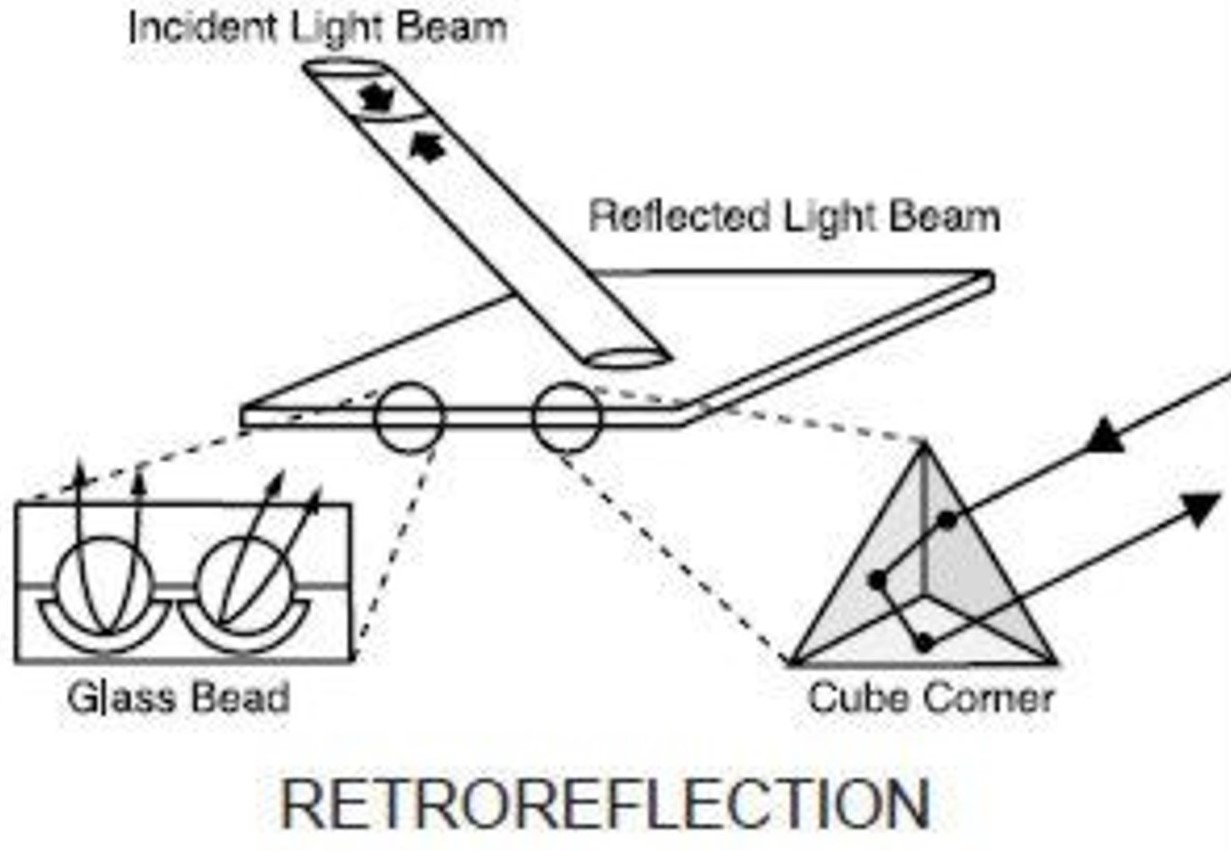
In glass bead retroreflection (L), incoming light bends as it enters the glass bead, reflects off the back surface, and then bends again as it exits. In prismatic retroreflection (R), incoming light reflects off each surface of the cube, returning in a direction parallel to the incident light.
While both types of retroreflectives work for the traffic signage market, the recommended reflective sheeting alternative fails to meet the specific performance requirements of utility applications. Here are three reasons why:
Appearance
Prismatic lens reflective materials have a very pronounced honeycomb-like appearance due to the nature of the cells that are necessary for the prismatic lens to perform. While this honeycomb pattern doesn't really provide any objectional visual background distraction behind the larger graphics on a traffic sign, it can provide a distracting background to the smaller graphics required on, for example, a typical 5” x 8” warning label on a padmount transformer.
Glass bead lens materials, conversely, have a homogenous, uninterrupted visual appearance that does not distract from the smaller graphics that typically accompany the sign and label sizes used for safety and asset identification marking products.
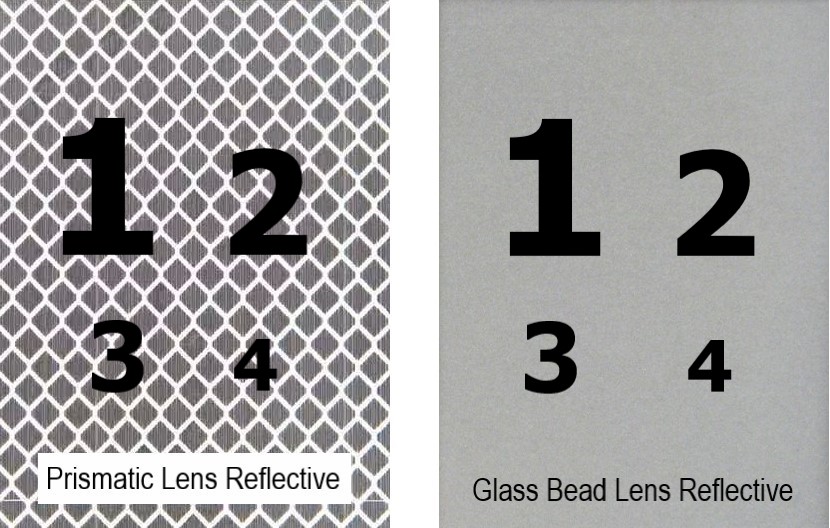
Notice how the printed text is difficult to discern against its background on the prismatic reflective (L), especially as the text gets smaller. The text on the glass bead lens reflective (R) is not difficult to discern against its background at all.
Thickness & Stiffness
Because of their construction, prismatic lens reflective materials are relatively thick—on the order of ~0.012”. The layer that composes the actual cube-corner embossed prismatic lenses is also a stiff material. These properties result in a material that does not respond well to conforming over surfaces other than those that may be flat or gently curved. Adhesion will be limited on textured surfaces.
While this property provides no challenge on a large, smooth, flat panel aluminum traffic sign (thanks to laminating equipment in a factory-controlled process), it can be difficult to install as an end-user in the field, given the sometimes less-than-optimal surfaces it may need to be applied on.
On the other hand, glass bead lens reflective materials are thinner—on the order of ~0.007”—and the layer of independent tiny glass bead lens elements allows a greater deal of flexibility when applied to textured surfaces.
Durability
As asset identification numbers (like the ones typically assembled into compatible panel holders, used for pole marking and the like), prismatic lens materials generally do not perform well, as they cannot be embossed without crushing or cracking the lens elements. Prismatic lens materials also do not cut well for computer- or plotter-cut type graphics.
Glass bead materials, being a homogenous film, can be easily embossed and plotter-cut without compromising performance.
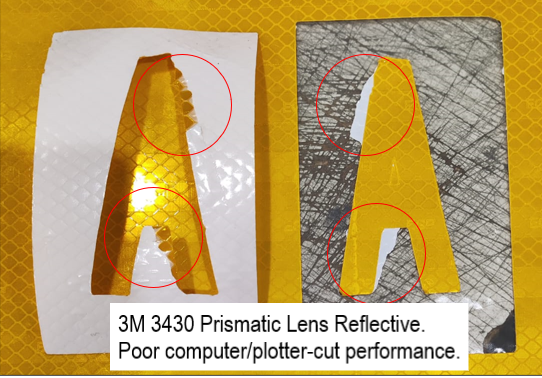
Prismatic lens reflectives bend light at slightly different angles, causing pronounced color fringing and resulting in a low-quality graphic.
More information on these materials and lens types can be explored in other blog topics, including Choosing the Right Reflective and Reflecting on Retroreflectivity.
Maintain Your Specs With Electromark's ASTM-Compliant Reflective Sheeting
Manufacturers can discontinue different materials or products for many reasons, including diminished profitability, reduced demand, changing manufacturing technologies and efficiencies, and primary user behaviors and needs.
In the case of retroreflectives used primarily for traffic signs, the newer materials are not necessarily better or even suited for all safety and asset identification products. For professionals in the electrical utility industry space, 3M™'s replacement options are not equivalent to the original material, as they use prismatic lens types that are less-suited to many of the products used in safety applications.
3M™ has provided previous indications of abandoning their commitment to manufacturing glass bead lens reflectives. Luckily, 3M™ isn't the only manufacturer of traffic-grade reflective sheeting.
Electromark partners with a network of reflective manufacturers in continued support of your current specifications, and we provide a suitable replacement for 3M™'s discontinued glass bead lens reflective. We understand that glass bead lens materials have likely already been qualified by your utility and incorporated into your specifications, and by offering you a glass bead material equivalent, we save your team the time and money associated with re-qualification and specification revisions.
Our material is a direct equivalent specified under ASTM D4956, which is the standard by which all retroreflective traffic sheeting materials are specified. ASTM D4956 categorizes all retroreflective materials by not only lens type, but also by required critical performance requirements—including color, retroreflective performance, adhesion, and durability.
If possible, stay with an existing material that delivers the necessary performance, saving you from having to qualify new materials and write new specifications. Don't get pushed into alternate materials that don't work for you, especially if there are equivalent options to what is already proven as effective.
The Electromark Difference
Electromark proactively mitigates supply chain risk by cultivating partnerships with a wide range of manufacturers. Our diverse supplier network allows us to respond instantly to material discontinuations and seamlessly transition you to an equivalent material without disrupting your operations.