
View More
Articles
- 5 Label Material Myths, Debunked
- When To Add 811 Reminders To Safety Products
- What Are Low-Temperature Adhesives?
- Custom Solutions For Transmission Tower Marking
- String, Wire, Or Nylon Cable? Choose The Right Tie
- The Best Materials For Fleet Marking
- The Most UV-Resistant Label Material
- 6 Ways To Make Your Spec More Competitive
- Understanding OSHA 1910.269 Tagout Rules
- Adhesive Options For Painted Metal Surfaces
- A History of Zap The Safety Bird
- Requirements Of Photovoltaic System Marking
- 10 Design Tips For LOTO Tags
- 8 Design Tips For Transformer Labels
- Designing Multilingual Messages: What's Required?
- Correctly Specify ANSI Safety Colors
- Your Safety Labels Have A Shelf Life
- Elements Of A Strong Safety Message
- Using Retroreflective Materials For Signs & Labels
Standards & Regulations Content
- Guide To 3M™ 3200 Reflective Sheeting Alternatives
- Guide To ANSI Z535 Compliance For Safety Signs
- 6 Ways To Make Your Spec More Competitive
- Understanding OSHA 1910.269 Tagout Rules
- A History of Zap The Safety Bird
- Requirements Of Photovoltaic System Marking
- 8 Design Tips For Transformer Labels
- Designing Multilingual Messages: What's Required?
- Correctly Specify ANSI Safety Colors
- Elements Of A Strong Safety Message
Best Practices For Substation Marking
Substation safety signage requires careful consideration of industry codes and practical application strategies. Understanding code requirements, proper material selection, and optimal placement ensures that safety messages remain compliant, durable, and effective.
Code
The driving standard for substation safety signage is the National Electrical Safety Code (NESC), which is adopted as code in full or part by most states.
What the NESC requires for fenced or walled enclosures without a roof is straightforward: a safety sign must be placed beside the door at each gate or entrance, and a safety sign must be displayed on each exterior side of a fence or wall enclosure.
Best Practice
Materials
Aluminum is a great performing material for the price, offered by many manufacturers, and is the most commonly specified material for outdoor sign applications.
However, utilities frequently express valid concerns over theft due to the high scrap value of aluminum. In fact, scrap theft is a primary reason many utilities incorrectly attach their signs behind the mesh on fenced enclosures—a practice clarified by the NESC to explicitly require installation on the exterior side. Mounting a sign behind the fence mesh improperly obscures the safety message.
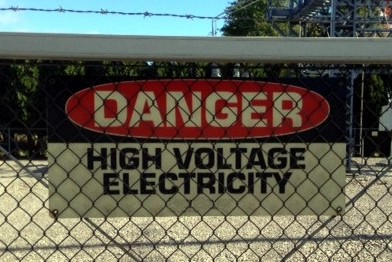
Where theft is prevalent, consider long-lasting, cost-effective materials with insignificant scrap value to create a recognizable disincentive to theft. Alternate materials with limited to no scrap value include polycarbonate or fiberglass signs, which can also offer greater weathering durability than aluminum.
Attachment
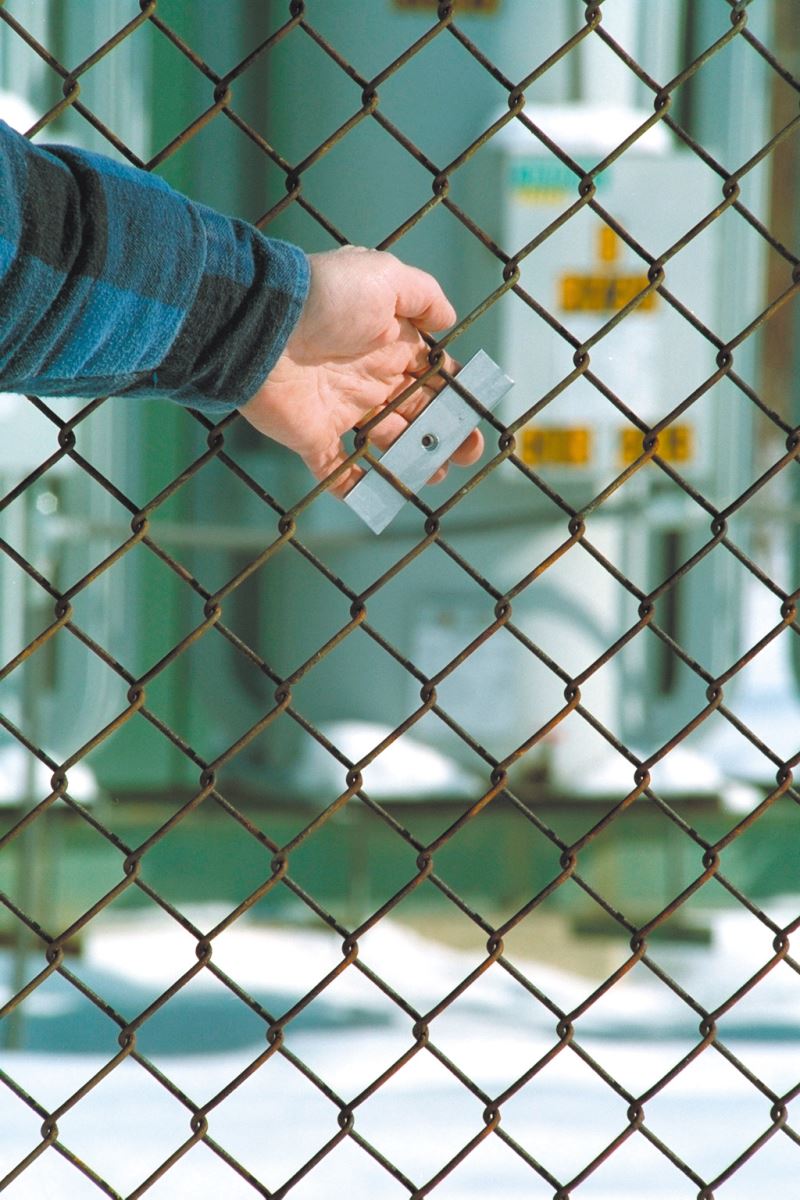
Wide openings in chain link fencing present a challenge when using commonly available nut, bolt, or washer hardware.
Protect your sign investment by using application-specific fence clip brackets offered by Electromark. These function by providing a larger bearing "washer" surface that spans an entire fence link opening. These clips can be purchased with tamper-resistant one-way screws and corrosion-resistant materials. They also offer the convenience of single-person installation from outside the enclosure.
Signal Word Choice
Utilities often default to the DANGER signal word in a well-intended effort to convey the highest level of seriousness, believing it covers all circumstances. However, a main intention of the ANSI Safety Sign standard is to limit the proliferation of DANGER strictly to circumstances where it is warranted. Overusing it risks conditioning the public and workers toward laxity when facing lower-level hazards.
- DANGER indicates an imminent hazard where there is direct exposure to energized parts.
- WARNING indicates a potential hazard where individuals are safe in their current position, but going beyond the barrier presents danger.
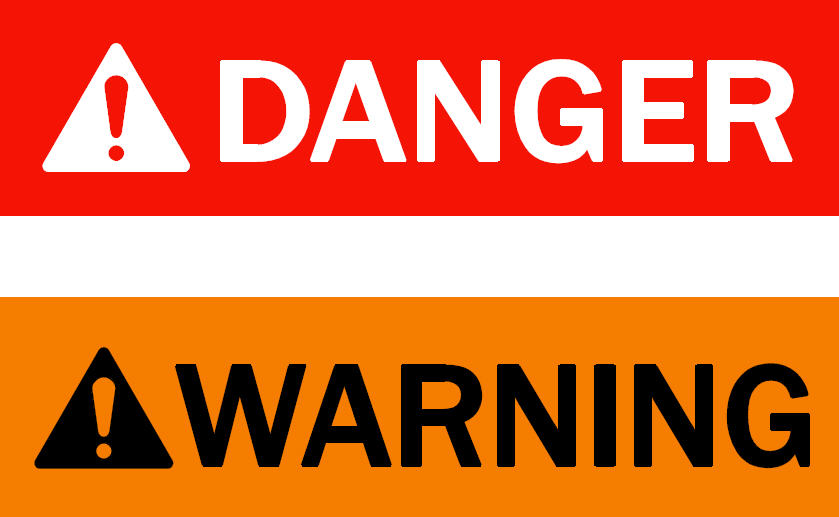
This makes WARNING the appropriate header word choice for signs posted on the outside of perimeter fences or walls.
Placement Spacing
While code requires a safety sign at each entrance and on each side of an enclosure, one sign per side of a substation enclosure may not provide adequate protection. This is especially true when the enclosure is particularly long, or when viewing angles prevent the message from being read.
Consider the following placement factors:
- Character Height: Larger letter characters can be read from greater distances; character height relative to safe viewing distance is specified in ANSI Z535.2.
- Viewing Angles: Sign readability significantly deteriorates at angles greater than 60 degrees from the perpendicular face of the sign.
Ensure the sign message can be read from a safe viewing distance at all approach angles to each side of an enclosure. The NESC Handbook notes that signs spaced at between two and three times the determined safe viewing distance prove most effective in general practice. Further elaboration and guidance can be found in Appendix B of the NESC companion handbook.