
View More
Articles
- 5 Label Material Myths, Debunked
- When To Add 811 Reminders To Safety Products
- What Are Low-Temperature Adhesives?
- Custom Solutions For Transmission Tower Marking
- String, Wire, Or Nylon Cable? Choose The Right Tie
- The Best Materials For Fleet Marking
- The Most UV-Resistant Label Material
- 6 Ways To Make Your Spec More Competitive
- Best Practices For Substation Marking
- Understanding OSHA 1910.269 Tagout Rules
- Adhesive Options For Painted Metal Surfaces
- Requirements Of Photovoltaic System Marking
- 10 Design Tips For LOTO Tags
- 8 Design Tips For Transformer Labels
- Designing Multilingual Messages: What's Required?
- Correctly Specify ANSI Safety Colors
- Your Safety Labels Have A Shelf Life
- Elements Of A Strong Safety Message
- Using Retroreflective Materials For Signs & Labels
Standards & Regulations Content
- Guide To 3M™ 3200 Reflective Sheeting Alternatives
- Guide To ANSI Z535 Compliance For Safety Signs
- 6 Ways To Make Your Spec More Competitive
- Best Practices For Substation Marking
- Understanding OSHA 1910.269 Tagout Rules
- Requirements Of Photovoltaic System Marking
- 8 Design Tips For Transformer Labels
- Designing Multilingual Messages: What's Required?
- Correctly Specify ANSI Safety Colors
- Elements Of A Strong Safety Message
A History of Zap The Safety Bird
In the 1980’s, a communication supervisor at Ontario Hydro (Hydro One) created a campaign featuring a cartoon bird named, “Zap the Safety Bird”. Designed as a safety initiative aimed at keeping children aware and safe from electrical hazards, Zap is also typically found on hazard labels in Canada.
In the safety campaign, Zap was a pelican with a red ball cap worn backwards, flying overhead spotting electrical hazards and flying down to warn children before they were injured.
The well-intended initiative reached its young target audience with media such as educational comic books, color-in activity books, and novelty items such as buttons, stickers, and punch-out ‘balancing bird’ cards.
While utilized as a safety symbol on labels across Canada, Zap the Safety Bird was primarily promoted as a safety awareness campaign in the Eastern provinces of Ontario and Quebec.
As a safety symbol image on labels, Zap has often been the subject of ridicule and mockery. As a label manufacturer, we’re frequently asked questions essentially all asking, “What exactly is that thing supposed to be?” We’ve heard it thought to be everything from a mutilated chicken to a mangled deer.
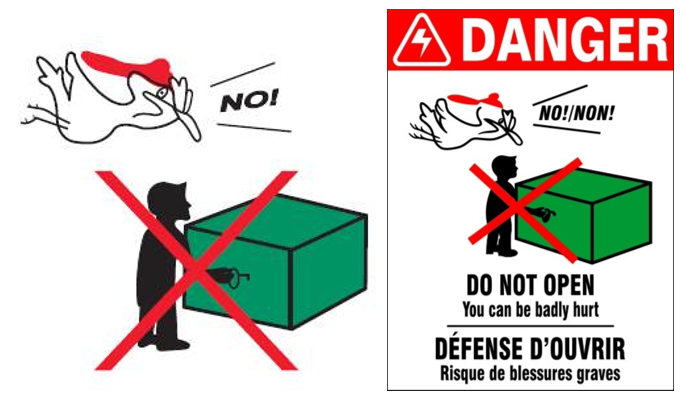
Confusing images of Zap typically illustrated on safety labels
It is my conjecture that the problem began with some of the animated depictions of Zap having never been exactly clear as to what he was supposed to be to begin with. Then adding to the confusion, graphic artists designing labels attempted to recreate Zap from these examples, further distorting the image.
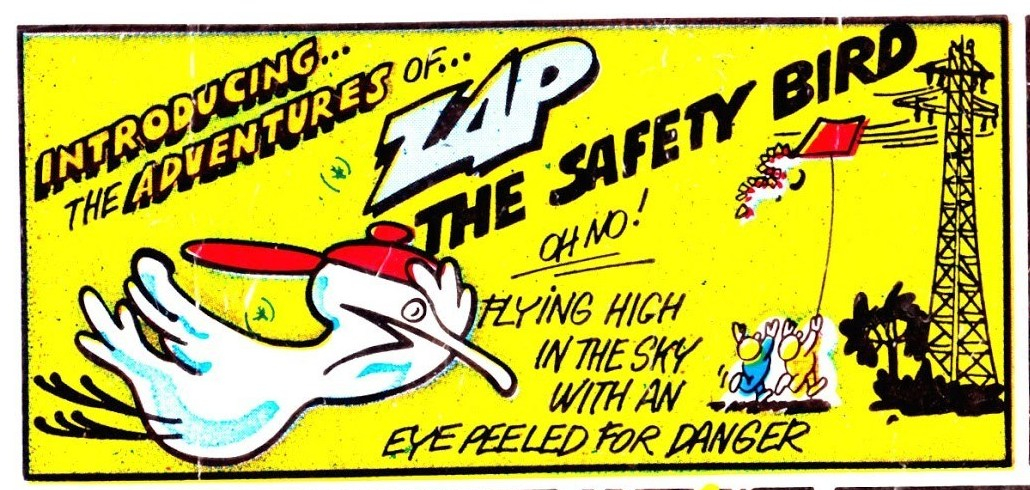
Below is an example of the ‘proper’ illustration of Zap being used in the safety campaign. This comic provides an example of one of the possible source figures from which the character on the labels in photos above may have been interpreted.
In this comic, Zap is raising one wing to his brow to keep his ‘eye peeled’ for hazards before they hurt someone. The other wing is swept back and upward as he glides above.
Is Zap The Safety Bird An Effective Safety Symbol For Signs And Labels?
Examined through the lens of the American ANSI Z535 Standards for presenting accident and safety information, the simple answer is no, Zap is not effective as a safety symbol for signs and labels.
Representational versus abstract symbols are preferred and have been demonstrated to be more effective at communicating hazards (ANSI Z535.3-2017 Criteria for Safety Symbols, Paragraphs A4.1, A4.3, B2.5.6).
By itself, the depiction of Zap is not even an abstract representation of anything but a bird, and on a safety sign provides no understanding towards the identification of the potential hazard type or desired or prohibited actions to avoid the hazard.
Zap the Safety Bird however was probably not developed with the idea of using it as a safety symbol on signs and labels, and was likely only adopted as such after it was believed it had gained awareness recognition among children.
As a safety initiative built around a character that supposedly provided appeal to children however, Zap was most likely an effective delivery vehicle to teach electrical hazard safety.
It is my understanding that the safety initiative built around the Zap character has not been active for several decades, and children today have no recognition of Zap and the electrical safety awareness the character taught.
Without the comprehensive initiative to reach the intended audience of children, the effectiveness of Zap as a safety symbol is lost.
Where Do Canadian Safety Standards For Electrical Utility Operations Stand On Zap Today?
Some CSA Standards for Electric Utility Operations such as CSA 22.3 No.7-15 Underground Systems still include examples of electrical hazard warning labels with Zap the Safety Bird. And many Canadian utilities still specify Zap the Safety Bird labels within their design standards.
However, most progressive Canadian utilities have become educated to and are migrating towards using the superior ANSI and ISO design standards for their safety and hazard alerting signs, tags, and labels.