View More
Articles
- 5 Label Material Myths, Debunked
- When To Add 811 Reminders To Safety Products
- What Are Low-Temperature Adhesives?
- Custom Solutions For Transmission Tower Marking
- The Best Materials For Fleet Marking
- The Most UV-Resistant Label Material
- 6 Ways To Make Your Spec More Competitive
- Best Practices For Substation Marking
- Understanding OSHA 1910.269 Tagout Rules
- Adhesive Options For Painted Metal Surfaces
- A History of Zap The Safety Bird
- Requirements Of Photovoltaic System Marking
- 10 Design Tips For LOTO Tags
- 8 Design Tips For Transformer Labels
- Designing Multilingual Messages: What's Required?
- Correctly Specify ANSI Safety Colors
- Your Safety Labels Have A Shelf Life
- Elements Of A Strong Safety Message
- Using Retroreflective Materials For Signs & Labels
Lockout Tagout Content
String, Wire, Or Nylon Cable? Choose The Right Tie
Much of the equipment infrastructure in the electrical utility industry that needs to be locked out during service or repair work is a functioning component of a large, complex distribution network.
Some of these applications may not be able to accommodate a locking device and therefore may need to rely on tags and other procedural controls alone.
Even for applications where lockout is possible, a tagout hazard/safety notification is often also necessary to supplement the physical lockout/de-energization of equipment.
And while utilities are certainly aware of the procedural work rules and required points of use for tagout operations required by OSHA regulations and electrical construction/work codes, they sometimes are not aware of what attachment means to order.
Commonly Available Options
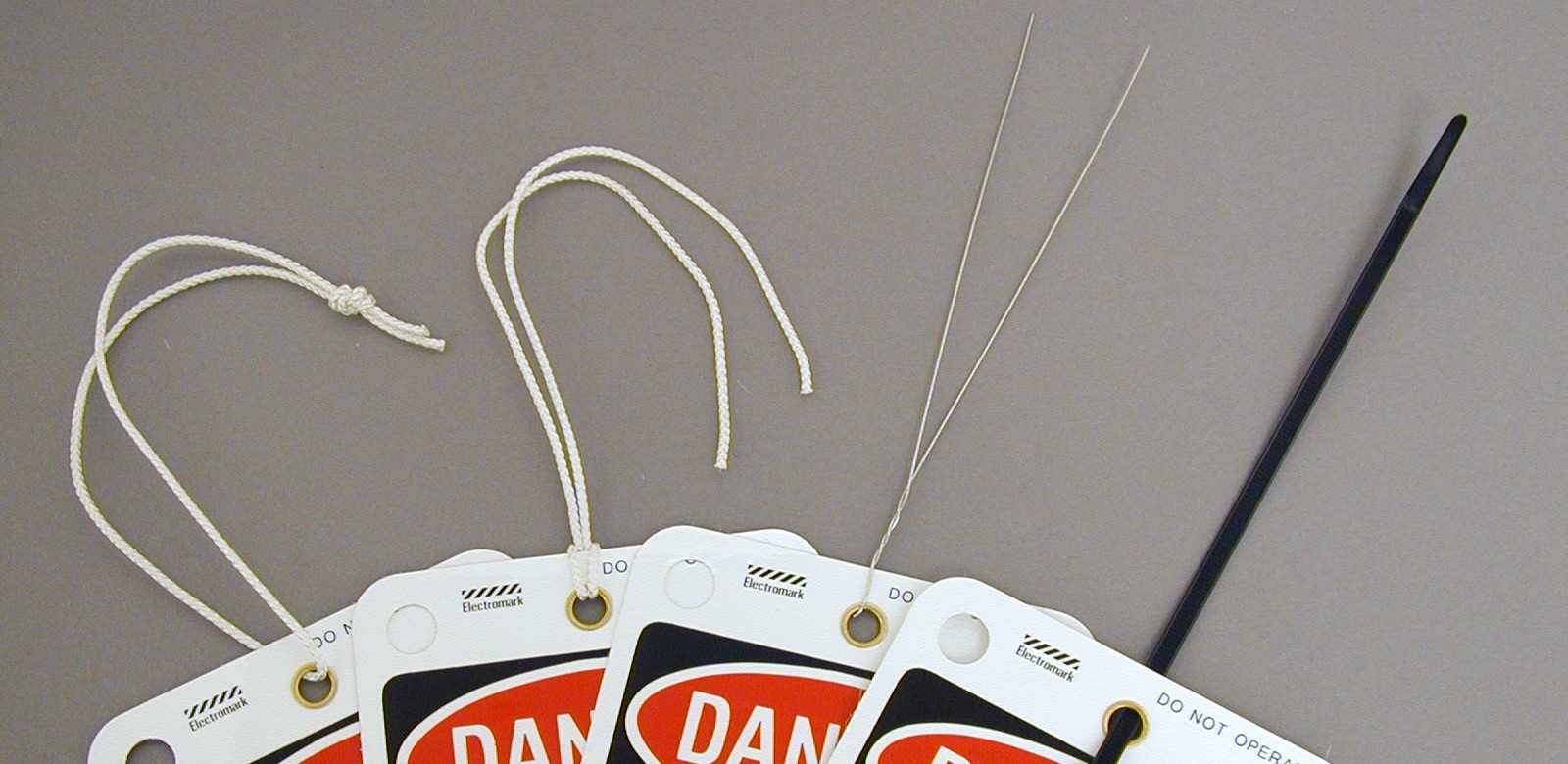
Commonly available options include string, wire, and nylon cable ties (aka ‘zip ties’).
String is inexpensive, and can be sourced in different strengths and materials such as cotton or nylon; offering different weathering and durability performance.
Other than being metal, wire offers similarly variable options as string, and is easy to twist on and then simply untwist again when finished with use.
Zip ties, though relatively inexpensive, are more costly than string or wire.
Zip ties are easy to use, are appropriate for all environments, come in UV resistant varieties, different lengths, and strengths, and also find use in a variety of other useful applications.
What Do Regulations Require?
The sections of OSHA Regulations 29 CFR 1910.147 The control of hazardous energy, and 1910.269 Electrical Power Generation, Transmission, and Distribution that pertain to strength requirements for tagout devices include 1910.147(c)(5)(ii)(C)(2) and 1910.269(d)(3)(ii)(D). Each of these paragraphs is worded identically stating:
“Tagout devices, including their means of attachment, shall be substantial enough to prevent inadvertent or accidental removal. Tagout device attachment means shall be of a non-reusable type, attachable by hand, self-locking, and non-releasable with a minimum unlocking strength of no less than 50 pounds and shall have the general design and basic characteristics of being at least equivalent to a one-piece, all-environment-tolerant nylon cable tie.”
So what does that mean?
The wording of the OSHA regulations is pretty clear towards the type of attachment device that is specified.
String and wire are both available with 50 lbs. or greater tensile strength and can be attached such that it would require 50 lbs. or greater force to compromise the knot (string) or twist (wire) point of attachment.
But these means of attachment fail to meet the requirement of being non-reusable, self-locking, non-releasable and having the specified general design and basic characteristics of a one-piece nylon cable tie. So for safety tagout operations required by OSHA regulations and electrical construction/work codes, string and wire are simply not an option.
String and wire can, however, be appropriate for non-safety tag applications, and are typically used with equipment inspection, equipment maintenance record, and inventory ID tags.
Electromark Has The Attachment Tie You Need
We offer string, wire, and nylon cable ties as accessory options with our wide tag variety.
Electromark’s nylon cable ties are manufactured from weather resistant 6/6 nylon, with UV light-absorbing stabilizers incorporated into the resin for extended outdoor use and sunlight exposure performance.
We offer 7″, 11″, and 14″ standard tie lengths and all of our ties are specified to meet the 50 lbs. unlocking/break strength with the self-locking, non-releasable head design required by OSHA regulations.